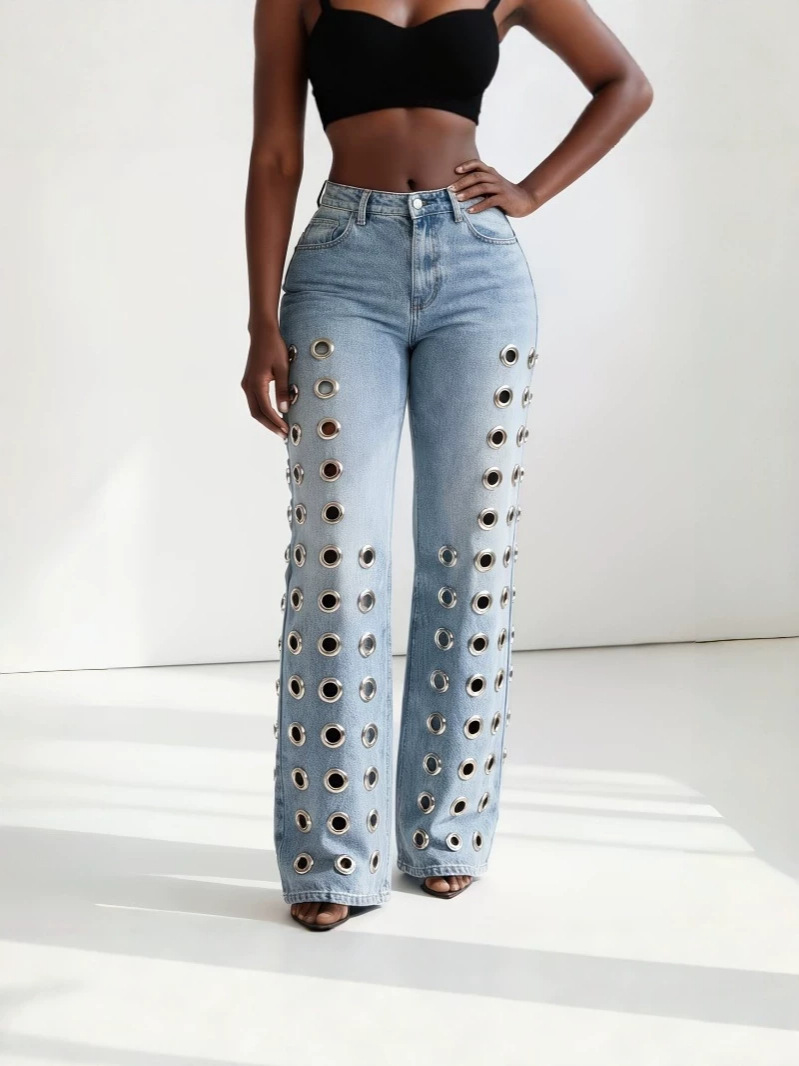
Few silhouettes in women’s denim have sparked as much quiet debate as the choice between a straight leg and a wide leg. On the surface the question looks simple: one leg tapers, the other flows. In practice, the decision touches proportion, fabric behavior, the mechanics of how a trouser hangs from the hip, and the sort of shoe or jacket that completes the look. Straight leg vs wide leg jeans are not competing answers to the same need. They are two distinct tools, each built to solve a different styling problem, and understanding why one succeeds where the other falters is the fastest route to a wardrobe that looks considered rather than accidental.
The straight leg emerged from the post-war workwear tradition, where a narrow, uniform leg allowed for a clean line under boots and a predictable break at the ankle. It remained a fixture of American and European casual dress for decades, gradually softening from rigid utility into a more tailored everyday staple. The wide leg has a different lineage. Its roots run through the bell-bottoms and flared trousers of the 1960s and 1970s, the sailor-influenced cuts of earlier eras, and the tailored palazzo traditions of Mediterranean dressmaking. Each cut carries a set of cultural signals, and wearing one with confidence means recognizing those signals rather than simply copying a trend report.
Etiquette matters here more than many shoppers expect. A straight leg reads as neutral and versatile, appropriate for offices with relaxed dress codes, weekend errands, and evenings out where the rest of the outfit does the talking. A wide leg, by contrast, asks for intention. It works beautifully in an elevated casual setting, particularly when the top is fitted and the shoe has some architecture to it, but it can overwhelm a petite frame or look unfinished when paired with sneakers that were chosen out of convenience. Before choosing, consider the occasion, the hemline you intend to wear, and whether you want the trouser to recede or to become the focal point of the outfit.
This guide approaches the question the way a tailor would: starting with silhouette and proportion, moving through textile weight and drape, examining how the garment is built, considering footwear and outerwear, and finishing with practical fit troubleshooting. The goal is not to declare a winner. It is to give you the vocabulary and the judgment to decide, garment by garment, which cut will serve you.
1. Reading Silhouette and Proportion Before You Commit
Silhouette is the first thing the eye registers and the last thing most shoppers analyze. A straight leg creates a continuous vertical line from hip to hem, with a width that stays relatively constant from the thigh through the knee and tapers only modestly toward the ankle. This line elongates the leg visually because the eye follows a single, unbroken path. For shorter wearers or anyone who wants a streamlined outline, that continuity is the chief advantage. The trouser sits close enough to the body to suggest the leg beneath it without clinging.
A wide leg works on a different principle. Its width begins at the hip or thigh and expands, sometimes dramatically, toward the floor. The visual effect depends almost entirely on the balance between the top and the bottom. Pair a voluminous leg with an oversized sweater and the whole figure can read as a single amorphous shape. Pair it with a tucked or cropped top and the waist becomes the anchor, and the trouser becomes a deliberate counterpoint. Many experienced stylists describe this as the “proportion rule”: wide volume below calls for defined structure above.
Rise plays a decisive role in both cuts. A high rise, sitting at or just above the natural waist, lengthens the torso and gives a wide leg its best architecture. A mid or low rise can make a wide trouser look as though it is sliding downward, which is why the silhouette on the wide leg is so sensitive to where the waistband lands. Inseam and total length matter equally. A wide leg that breaks at the shoe or grazes the floor creates a clean column; one that stops awkwardly at the ankle can shorten the leg and cut the figure in half.
To test your own proportions, stand before a mirror in the two cuts you are weighing and look at three points: the width at the thigh, the position of the waistband relative to your natural waist, and the hem in relation to your footwear. If the straight leg creates a line that feels long and clean, it is likely the right choice for a day-to-day wardrobe. If the wide leg makes your waist look defined and your legs look longer rather than shorter, it may be the more flattering option for a special occasion or a statement outfit.
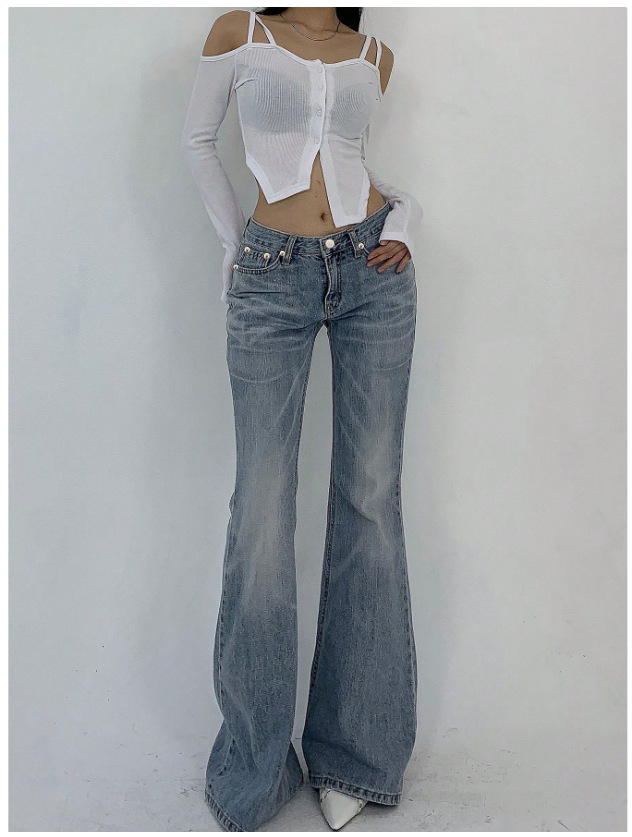
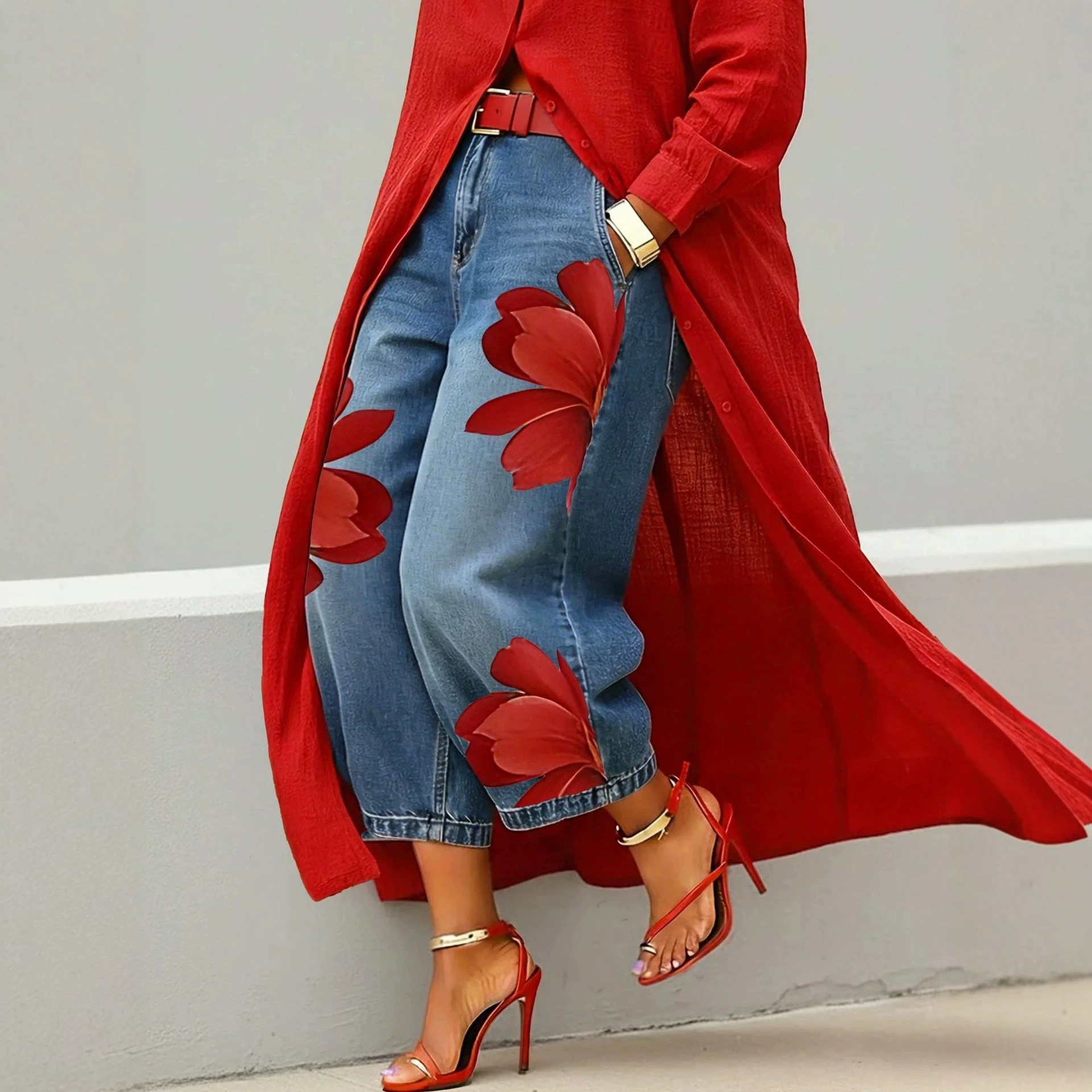
A high-rise flared cut in vintage blue denim, where a defined waist anchors the volume below.
For a closer look at a wide-leg silhouette that rewards this kind of proportional thinking, The Blanche Vintage Blue Flared Denim Jeans illustrates how a sharp waist and generous hem can coexist without overwhelming the frame.
2. Textile Weight, Weave, and Drape
The fabric determines how a silhouette actually behaves on the body, and this is where the straight leg and wide leg diverge most sharply. Denim is measured in grams per square meter (GSM) and in ounces per square yard, and the weight of the cloth shapes everything from how the leg stands away from the body to whether the knee bags after a day of wear. A straight leg in a mid-weight denim, roughly 11 to 13 ounces, holds its line without stiffness and softens gradually. A wide leg in the same weight may collapse under its own mass unless the fabric has enough body to hold a column shape.
Weave matters as much as weight. A right-hand twill, the standard denim construction, produces the familiar diagonal ribbing and a fabric that softens with washing. Stretch denim adds elastane to the weft, which improves comfort but reduces the crispness of a wide leg and can cause it to cling in unflattering places. Non-stretch rigid denim, by contrast, holds structure beautifully and is often the better choice for a full-length wide leg where volume is the point.
Drape is the final variable, and it depends on grain. Fabric cut on the straight grain (parallel to the selvedge) stands more firmly and gives a crisper outline. Fabric cut on the bias (at a 45-degree angle to the grain) has more give and falls in softer, more fluid lines. Most denim trousers are cut on the straight grain, which is why a wide leg in standard denim can look stiff while a bias-cut skirt in the same cloth would flow. Some designers introduce bias panels or slightly softer washes to encourage a more fluid hem on wide cuts.
| Factor | Straight Leg | Wide Leg |
|---|---|---|
| Ideal denim weight | 10 to 13 oz (mid-weight) | 12 to 14 oz (heavier, for structure) |
| Stretch content | 1 to 2 percent elastane acceptable | Rigid or minimal stretch preferred |
| Grain orientation | Straight grain for crisp line | Straight grain with softened wash, or bias panels |
| Best occasion pairing | Daywear, office casual, weekend layering | Elevated casual, evening with heels, statement outfits |
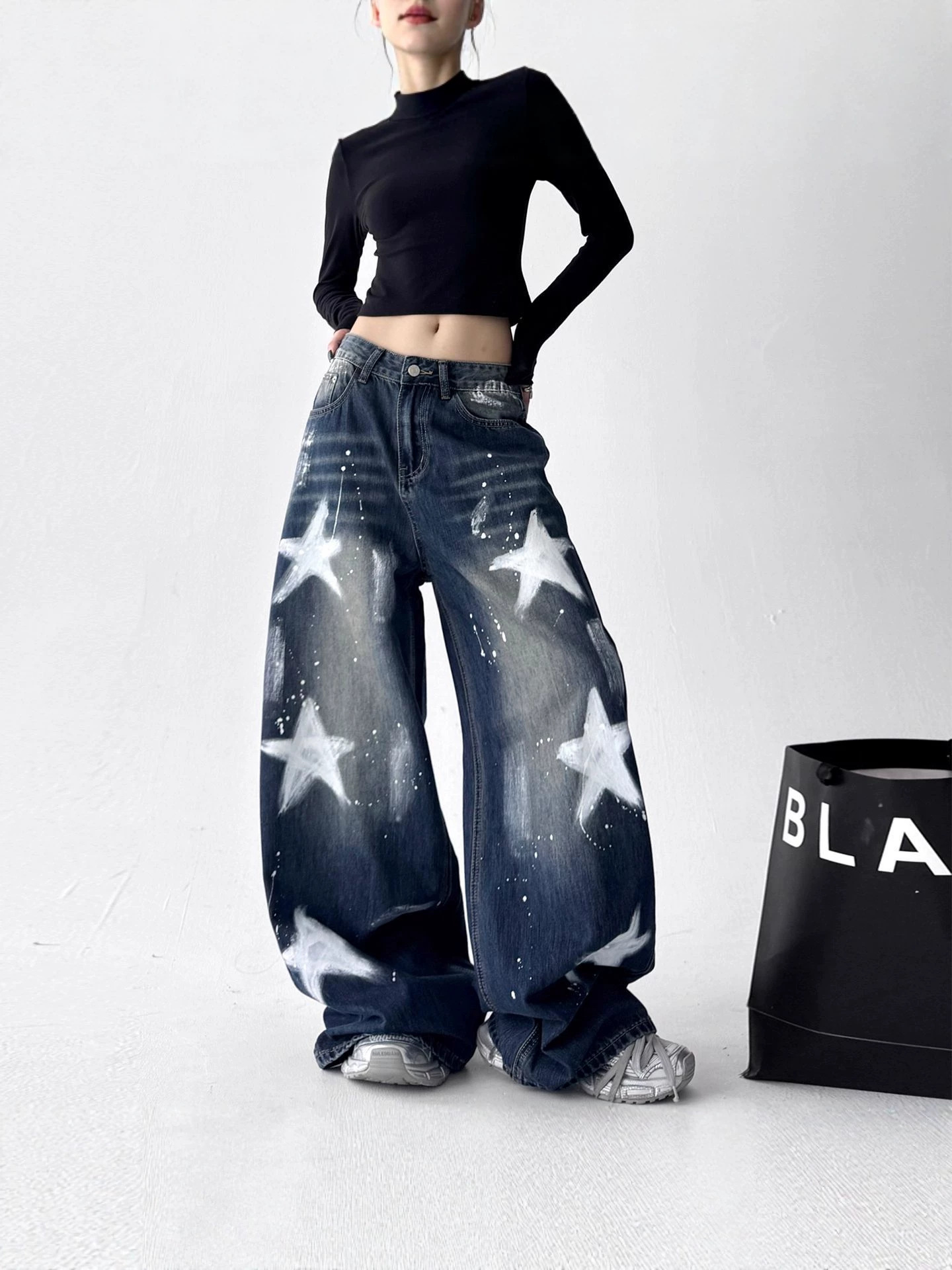
A wide-leg cut in a substantial denim, where the fabric weight carries the silhouette from hip to hem.
When evaluating a wide leg, look closely at the hand of the fabric. A cloth that feels overly thin will ripple and twist at the hem, while one with adequate body will hold a clean vertical fall. The Oceane Retro Star Graffiti Wide Leg Jeans demonstrate this principle well: the substance of the denim gives the leg enough architecture to stand away from the body without ballooning.
3. Garment Construction and Tailoring Details
The difference between a well-made straight leg and a poorly made one often lies in details that most wearers never see. Inside the leg, the seam allowance (the fabric beyond the stitch line) determines how much a trouser can be altered later. Generous seam allowances, often around half an inch on the inseam and outseam of quality denim, give a tailor room to take in or let out. Narrow allowances, common in fast-fashion production, limit future adjustments and can cause the seam to pucker under strain.
Wide-leg construction introduces its own challenges. Because the leg is cut with more fabric, the pattern must account for the way that volume falls. Inseam placement, the curve of the crotch, and the hip shaping all influence whether the trouser swings naturally or pulls toward the front. Many well-constructed wide legs incorporate a slightly higher crotch depth and a more generous seat so the fabric does not drag across the thigh when walking. The side seam is often cut with a subtle curve to echo the body rather than a straight line that can flatten the shape.
Interior finishing matters too. Denim trousers in quality construction typically feature a bar-tacked stress point at the fly and pocket corners, double-needle topstitching for durability, and a waistband secured with a sturdy interior stay. Some tailored denim uses a grosgrain waist stay (a ribbon sewn along the inside of the waistband) to prevent stretching and to keep the waist from sagging, which is particularly important for a wide leg where waistband tension must hold the entire cut in place. Silicone grip tape along the inside of the waistband, increasingly used in high-rise designs, prevents the shirt from riding up and keeps the trouser’s line intact through a full day.
For a sense of how heritage textile institutions document these mechanics, the Victoria and Albert Museum’s fashion collections offer a useful reference for how trouser construction has evolved across periods. Examining historical garments helps clarify why certain seam placements and waist treatments endure.
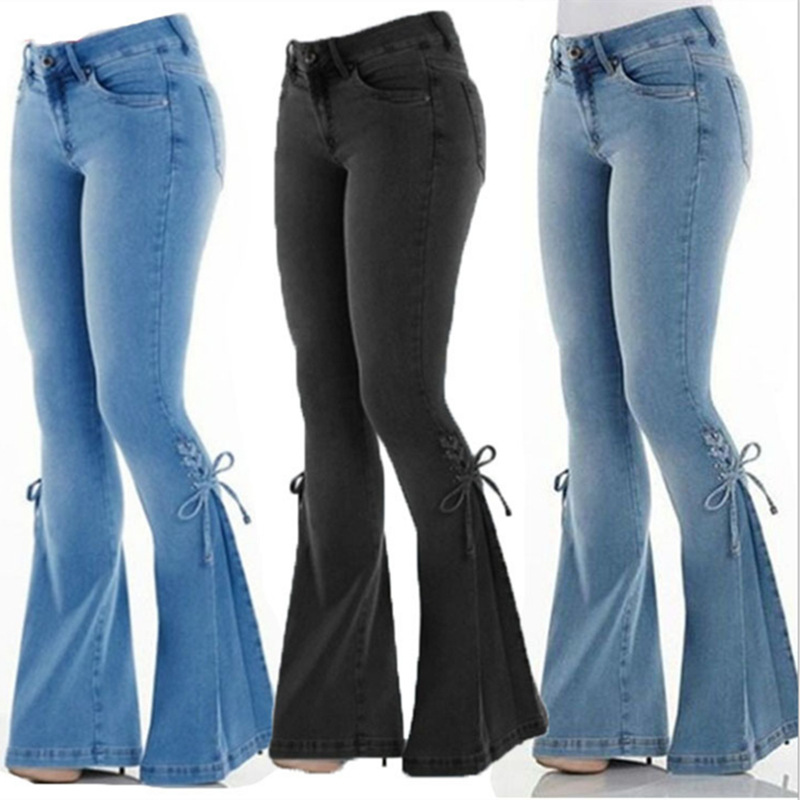
Front construction detail on a mid-waist denim trouser, showing how the seam and hardware sit against the body.
When you inspect a pair in person, check the crotch seam for reinforcement, feel the waistband for internal stays, and look at how the leg is seamed where it meets the hip. A detail like lace-up hardware, as seen in The Angele Jeans Mid Waist Lace Up Denim Pants, should be anchored securely with bar tacks rather than decorative stitching alone.
4. Footwear, Outerwear, and the Finishing Layer
Footwear determines whether a trouser looks intentional, and the two cuts respond to shoes in opposite ways. A straight leg, with its tapered hem, works under nearly anything: ankle boots, loafers, white sneakers, even a low block heel. The narrow hem allows the shoe to show without the fabric pooling awkwardly. Cropping the straight leg just above the ankle bone creates a clean, modern break, while a slightly longer hem can be rolled once for a relaxed effect.
A wide leg demands more deliberate pairing. Because the hem covers much of the shoe, the height of the heel and the shape of the toe matter. A platform sandal or block heel provides enough lift to keep the proportion balanced, and a pointed or square toe can echo the trouser’s architecture. Flat sneakers can work, but the hem should either just graze the shoe or be cut to show the ankle, otherwise the outfit can look shapeless. Many stylists recommend a hem that just kisses the floor in heels, which creates a column rather than a puddle.
Outerwear shifts the balance again. A straight leg slides easily under a tailored blazer, a trench coat, or a cropped leather jacket, and the continuous line reads as clean and efficient. A wide leg pairs best with an outer layer that defines the waist, such as a belted coat, a fitted jacket that ends at the hip, or a structured knit cardigan. Oversized outerwear on top of a wide leg can make the whole figure read as bulky unless the proportions are carefully managed.
Accessories should follow the same logic. A slim belt sharpens a straight leg without adding weight, while a wider belt or a chunky buckle can anchor a wide leg at the waist and reinforce the silhouette. Jewelry can be more expressive with a straight leg, since the trouser is quiet, but a wide leg already carries visual weight, so restraint often serves better. Bags should be sized to the outfit: a structured tote balances a wide leg, while a small crossbody suits the streamlined line of a straight cut.
A straight leg with a clean hem, shown in a silhouette that pairs easily with boots, loafers, or sneakers.
For everyday versatility, a straight leg is difficult to beat. The Capucine Straight Leg Jeans show how a tapered hem gives you room to move between boots in autumn and sandals in summer without restyling the whole outfit.
5. Fit Troubleshooting and Real-World Adjustments
Even the best cut can disappoint if the fit is off, and the two silhouettes fail in characteristic ways. A straight leg that feels too tight through the thigh usually indicates the rise is too short or the seat is cut too narrow for your body. Before reaching for a larger size, which can gap at the waist, check whether a different rise or a stretch blend with a bit more give would solve the problem. Remember that a straight leg should skim the thigh without pulling; horizontal creases at the front of the hip signal strain.
A wide leg that drags or pools is usually either too long or too low in the rise. Hem length is the easiest fix: a skilled tailor can take up the inseam while preserving the original hem shape, and for a wide leg, a hem that sits at the top of the shoe or just skims the floor in heels is the goal. If the trouser seems to slide down the hip, the waistband may lack structure. Grosgrain waist stays or a hidden hook-and-eye at the top of the fly can restore the position without changing the garment’s overall line.
Crotch fit deserves attention in both cuts. If the trouser pulls at the front or creates diagonal folds from hip to knee, the crotch depth may be too shallow. This is less common in wide legs because the generous volume often compensates, but it can still cause discomfort when sitting. A tailor can sometimes adjust this by letting out the seam, provided the seam allowance permits.
Finally, consider how the garment changes after wear. Denim relaxes at the knee and seat with use, which is more noticeable in a straight leg because the fit is closer to the body. Pre-washing is generally not recommended for raw or rigid denim, since it removes the initial shape and can lead to uneven fading. Instead, wear the garment for several days before deciding whether it needs alteration. A wide leg, meanwhile, can soften and drop slightly in the first few wears, so a fit that looks a touch long at purchase may settle into the ideal length. Measure twice, try multiple sizes when possible, and allow for the way the fabric will evolve.
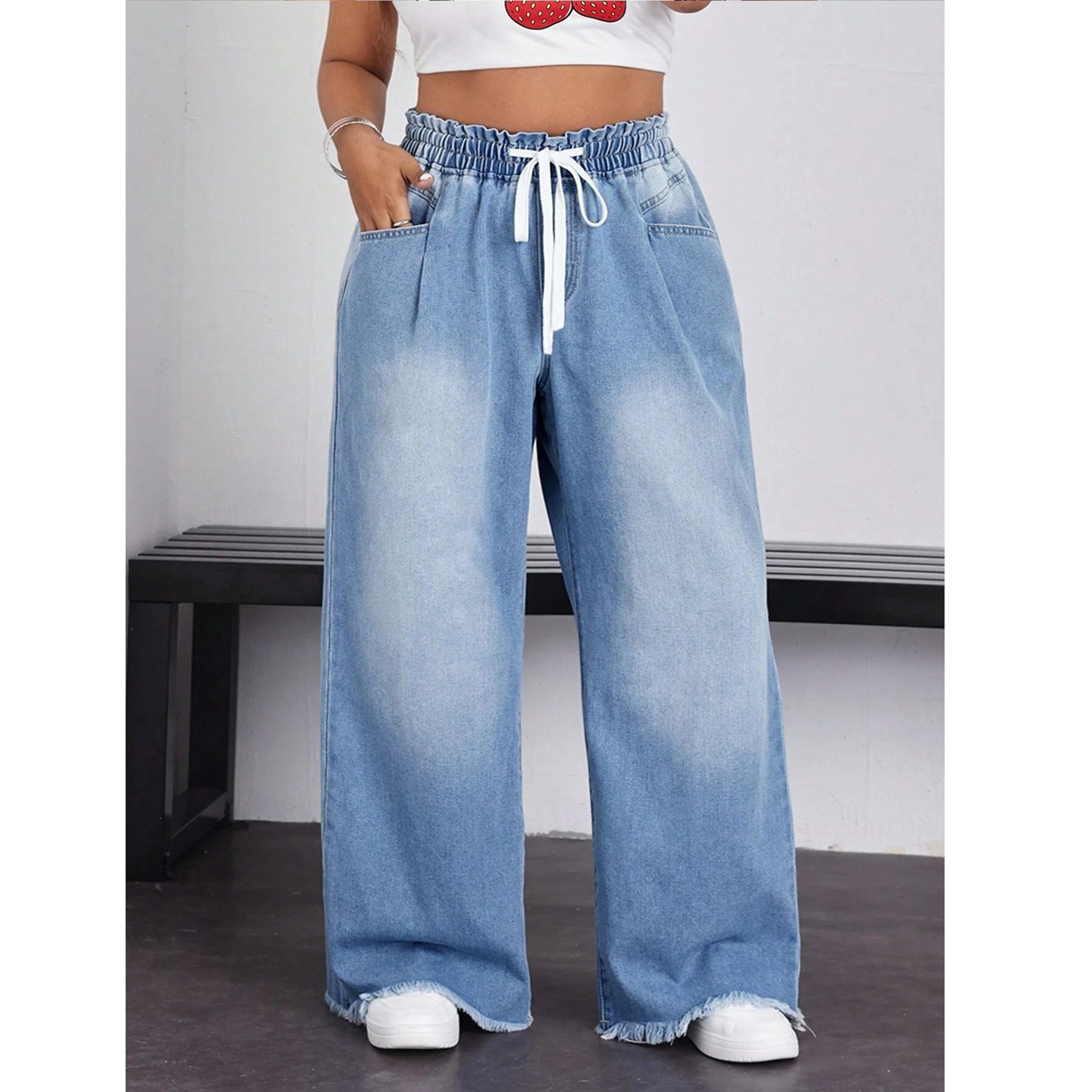
A drawstring waist offers adjustable fit, useful when a wide leg needs a little more control at the hip.
Drawstring and adjustable waists can ease the common tension between hip and waist measurements. The Elodie Drawstring Wide Leg Jeans Distressed Raw Hem Trousers illustrate how an adjustable waist can accommodate variation in body shape while keeping the wide silhouette intact. For a more fitted option in the same family, The Magali High Waisted Straight Leg Jeans offer a slimming cigarette line that sits close without restricting movement.
The Styling Takeaway
Choosing between a straight leg and a wide leg is ultimately a question of what you want the trouser to do. The straight leg is the workhorse: it extends the leg, pairs with almost any shoe or jacket, and moves easily from desk to dinner. Its strength is continuity and restraint, and it rewards a mid-weight, straight-grain denim with clean construction and a hem that suits your footwear. For most wardrobes, it will be the cut worn most often, and it deserves the investment in quality fabric and careful tailoring.
The wide leg is the statement, and it asks more of the rest of the outfit. Its volume depends on fabric weight, a defined waist, and shoes or outerwear that honor its proportions. When those elements align, it creates a silhouette of unusual confidence and ease. Whichever cut you choose, judge it by how it behaves on your body, how the denim has been constructed, and whether the hem and rise support the look you intend. A well-chosen pair, properly fitted and thoughtfully styled, will outlast any trend cycle.